FAEDRA
Faedra are an open species of dragon that are very spiritual and in tune with nature. There are different types of Faedra representing different elements or themes. Each are affiliated with a certain aspect from nature such as plants, animals or even the elements themselves. They form a spiritual bond with a particular piece of nature from birth, sharing a symbiotic relationship with the object they are bonded with. Their bonded objects are called aspects. They can sustain themselves just from being in the vicinity of their aspect, and in return release energy that benefits it in return.
Biology and physiology
Faedra are commonly very small, usually only maxing out at about 15 inches long from nose to tail. Some however belong to a very rare group who are connected with celestial bodies. These faedra can be enormous, reaching lengths of many miles and roaming the expanse of space where the can absorb the cosmic energy among it.
Earthbound faedra vary in all shapes and sizes They may be cold blooded but are able to thermoregulate themselves just fine, especially if near their bonded aspect. In fact, if their aspect is nearby, they don't need anything else to survive. Because of this, they don't tend to travel far from where their aspect is naturally located.
Each faedra have special organs on their bodies surrounded in the symbols that represent the aspect they've bonded with. More than one faedra can be bonded to the same aspect as another. These individuals share the same symbols, but rarely look similar otherwise.
Faedra are genderless and don't possess any sexual reproductive organs. To reproduce, two faedra will draw in the energy of the other in a special ritual, combining the energy into a single egg. After an egg is made, the parents place it in a safe, hidden place to allow it to grow in peace. The parents rarely stick around for the hatching.
It's unknown how exactly an aspect bond is formed, but from within the egg it is set. It isn't always inherited from either parent. Shortly after being formed, the symbol of their aspect appears on the egg, the same one shown on their necks. After a full year inside the egg, the baby faedra is ready to hatch. After hatching, they're first instinct is to search out their aspect so they can absorb it's energy for the first time. Sometimes it can be common and near the site of their hatching, other times they can be traveling for weeks, following the faint energy trail they can pick up on. Once found they bask in the sustaining energy almost completely immobile for weeks. During this period they are vulnerable to the elements or predators, but if they can make it through, they will most likely be strong enough to live very long healthy lives.
The lifespan of an earth faedra can span for many decades, usually reaching 100 years. Once they've lived out their life, their body will convert back into energy and go right back into the earth from where it came. Likewise if they are killed by an outside force, they don't leave any remains behind.
-Flora Faedra-
The most common type, flora's appearance leans more towards mammalian, though with a lot of insect qualities. Biologically, they are more reptillian despite their furry appearance. Their aspects are all types of plant life including flowers, trees, moss, and even fruits. Aquatic plants however are excluded since these faedra cannot breathe underwater.
They are the second smallest type of faedra, their length can be up to 15 inches from nose to tail.
They have at least one pair of antenna on their heads, sometimes multiple pairs. These are important as they can be used to pick up on the energy of their bonded aspects so that they can locate them. To them, it's like another sense that allows them to smell the energy and follow it like a scent trail.
Though they can survive solely on the spiritual energy of their aspect, they can eat, and enjoy doing so. Snacks that they tend to enjoy most are sugary sweets and fruits! They will however never eat anything related to their aspect.
Their symbols come in the form of two marks on the chest that mirror each other, and the ones on their tails being a combined version of the two. There can be one mark on the back, or multiple trailing along the spine.
-Mineral Faedra-
The next most common type are mineral faedras.
They are much more reptillian in appearance, being
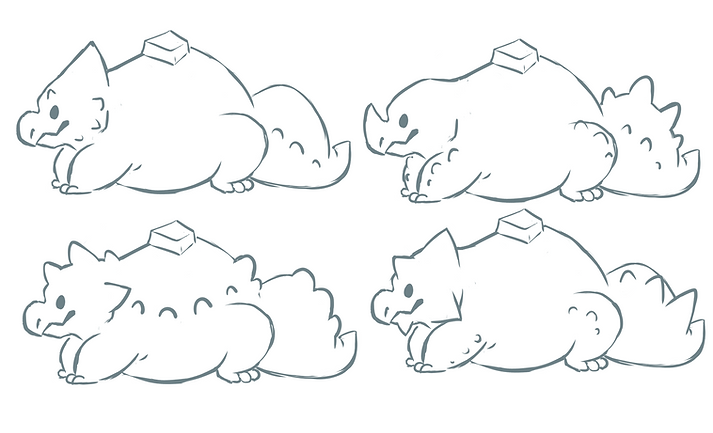
short and chunky with little to no fur on their bodies.
These faedra typically have small spikes or bumps on
many parts of their bodies, usually on their heads and tails.
These faedra are among the smallest of them all, most are only about 4 inches long, though some much older faedra can grow to 8 inches. Even though they're small, they are quite heavy, comparable to rocks of a similar size. In spite of that, they can still traverse cave walls with ease using the sticky pads on their toes.
Their aspects include all types of minerals and rocks, because of that they are almost always found in caves. The ones that do live in the dark tend to have poor eyesight, though they don't need sight to navigate the world around them as their smell alongside their spiritual senses are more than enough.
Because of their secluded cave dwelling life they have very little predators. As a result they have a tendency to be quite lazy, contributing to their plump stature.
Each of them have a stone on their backs that visually reflects the mineral they are bonded with. Though it is not actually made from the same material. This stone is how these faedra locate their aspects and draw energy from them. The symbols on these faedra are located around the stone and partially down their backs.
Like with the florals, they don't need to eat, but can choose to if they want. They like to munch on rocks not related to their aspect. While they are fine living communally, If a faedra in the area notices their aspect being eaten by another, they will often fight the other in a minor dispute. Though their easy going nature will allow them to move past it pretty quickly.
-Aquatic Faedra-
Coming soon!
-Elemental Faedra-
Coming soon!

Appearance and variations
-Flora Faedra-
-Mineral Faedra-
Mineral Faedra are small
and round with 4 legs and
scaly skin. They can be any
color or pattern you can
think of, these colors don't
need to reflect the stone
or mineral they are bonded
with. They can have any
combination of spikes or
bumps on their bodies,
usually these are very small
and not very sharp.
Their necks are short as well as their arms and legs.

Inside their mouths are round molar like teeth used for crushing the rocks that they eat.
On their feet are sticky pads that let them climb nearly any surface with ease.
Rules
There aren't many rules, they are an open species and anyone can make any number of them that they'd want for free! I will make some felted faedra every now and then and they will be up for sale or auction so you can own that particular dragon!
If you'd like to commission for a custom or to have your own design felted it would follow the same rules that i have for normal commissions! You can find more info here~
Even the patterns that are the same among the same aspects are more loose. When i make multiples of the same aspect i will use the same pattern, but it is up to you if you want to use the same pattern or make up your own. I don't have a list of patterns for every plant or object in existence so feel free to use your imagination and be creative!
You can follow the designs as stated above as closely as you want, but keep it within the lore of the species! (mineral faedra have no wings or fur, flora have insect wings only, etc)
One rule that i must enforce is you should tag me if you do create a design, It is important that i see them because it would make my day to see that someone else liked my silly guys enough to make one of their own!